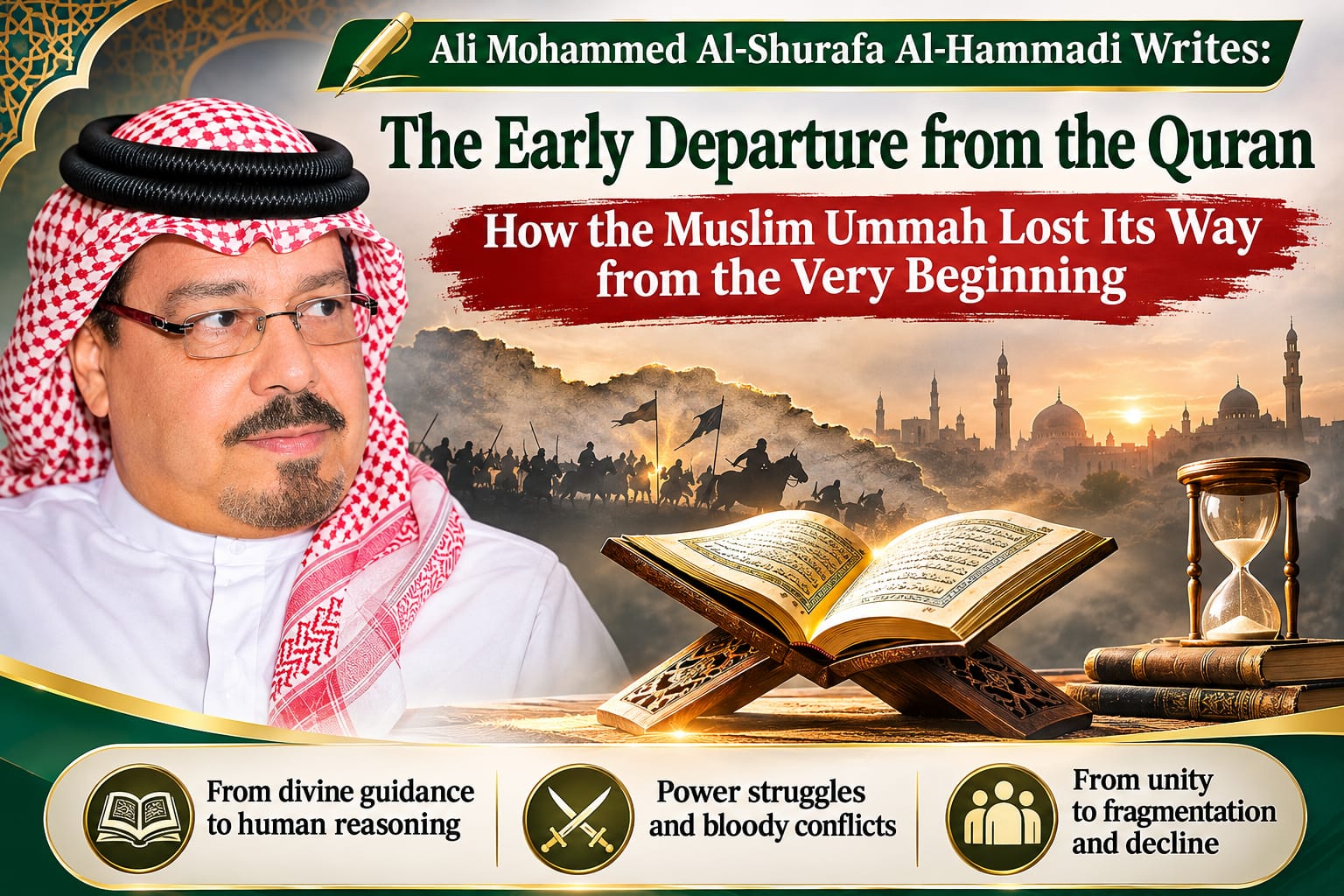
Ali Mohammed Al-Shurafa Al-Hammadi Writes: The Early Departure from the Quran — How the Muslim Ummah Lost Its Way from the Very Beginning

From the moment the Messenger, peace be upon him, departed this world, Muslims faced their first true test—not in slogans or emotional declarations, but in the extent of their commitment to God’s divine law and way of life, exactly as revealed, without addition or omission.
The Quran was the sole authoritative reference that the Messenger left to humanity: a governing scripture and a comprehensive framework regulating relationships, rights, and responsibilities. Yet what followed marked the first dangerous deviation, as this divine authority was set aside and the affairs of the Muslim community began to be governed by human judgments and interpretations lacking a decisive Quranic foundation. This marked the beginning of the abandonment of the Quran—not in recitation, but in governance and practical application.
Political disagreement soon escalated into bloody conflict. Blood was shed among those who had once fought side by side in defense of the Messenger and the sacred message he carried for the happiness and well-being of all humanity. Three of the caliphs were assassinated. The Battle of the Camel took place between forces associated with the Prophet’s cousin, Ali ibn Abi Talib, and his wife, Aisha. This was followed by the Battle of Siffin, in which Ali ibn Abi Talib confronted Muawiya ibn Abi Sufyan, both belonging to the Prophet’s extended family.
Conflicts subsequently continued between the Umayyads and the Abbasids, accompanied by successive wars and military campaigns, until the struggle for political power became the rule rather than the exception.
Even more alarming was the attempt to justify these catastrophes by portraying that period as the era of the Rightly Guided Caliphate, as though righteous guidance could coexist with bloodshed, the deaths of innocent people, and the absence of a clear Quranic foundation for political conduct.
What kind of guidance is this? What logic could possibly accept internal wars, assassinations, and political upheavals as a model of Islamic governance, when the Quran clearly establishes justice as the foundation of authority, declares human life sacred, and rejects the use of disagreement as a justification for bloodshed?
Then came the fighting against those who refused to pay zakat, despite the fact that, as the author argues, the Quran contains no command to wage war against someone for refusing to perform an act of worship. All acts of worship concern the relationship between the individual and God, and accountability for them belongs to the Day of Judgment, not to any earthly authority or caliph.
Here, a dangerous principle was established: religion was transformed from a relationship between human beings and their Creator into an instrument of coercion, with the sword raised over people’s heads in the name of obedience.
As generations passed, the distance from the Quran continued to grow. A scripture intended to provide guidance and legislation was gradually reduced to a book of recitation, blessings, rituals, and supplications for livelihood and the opening of doors to worldly opportunities.
Meanwhile, its higher objectives and essential teachings were neglected, and the divine roadmap to happiness, tranquility, and security faded from everyday life.
Thus, Muslims came to experience hardship and suffering despite the abundance of religious observances, because the divine way of life had disappeared from the practical realities of their existence.
These deviations continued until armies marched to conquer Persia and parts of Europe in the name of Islam rather than in accordance with Quranic values. Internal political struggles expanded into wars of conquest that, in the author’s assessment, lacked an ethical foundation.
The community became fragmented, the Muslim Ummah divided, and the caliphate deteriorated into hereditary and coercive rule, with successive dynasties and principalities overthrowing one another without religious or moral restraint.
This historical trajectory eventually brought us to our present condition of fragmentation, disorientation, and estrangement from the very essence of religion.
The question that now demands an unequivocal answer is this: Has the time not come for the Muslim intellect to recover its sound judgment and return to the sole divine authority that God commanded humanity to follow?
God Almighty says:
“This is a blessed Book which We have revealed to you, so that they may reflect upon its verses and those of understanding may take heed.”
Quran, Surah Sad (38:29) — English rendering of the meaning.
How can it be reasonable for the Quran to remain marginalized while human opinions and interpretations occupy the center of religious authority, as though they themselves were divinely revealed?
What occurred throughout Muslim history was neither a secret nor a conspiracy. Rather, it was the natural consequence of turning away from God’s divine law and way of life and following authorities other than God, despite the Quran’s explicit warning:
“Follow what has been revealed to you from your Lord, and do not follow other protectors besides Him.”
Quran, Surah Al-A’raf (7:3) — English rendering of the relevant passage.
God has granted human beings the freedom to choose between two paths, with no third alternative: either the path of guidance, tranquility, and salvation, or the path of misguidance, distress, and suffering in this world, followed by accountability in the Hereafter.
The Quran remains in our hands today, unchanged and uncorrupted. What has changed, however, is its place in our lives.
We must either restore it to its rightful position as the governing authority, the ultimate reference, and the guiding framework for human existence, or continue moving in endless circles of failure, division, and conflict—only to ask ourselves, time and again, why the Muslim Ummah has lost its way and why happiness, justice, and peace have disappeared from our lives.
O Allah, I have conveyed the message.
O Allah, bear witness.